
The next evolution of wealth is not just intelligence.
It is automation.
As users search for:
- Wealth app
- AI wealth builder
- Wealth automation tools
- Financial automation systems
A deeper shift is happening:
Wealth is moving from manual control to automated systems.
But there is a critical distinction:
Not everything should be automated.
The Core Idea
Wealth automation is not about removing human involvement.
It is about:
Eliminating inefficiency while preserving control
What Is Wealth Automation?
Wealth automation refers to systems that:
- Execute financial actions
- Monitor performance
- Trigger decisions
- Optimize processes
With minimal manual intervention.
Why Automation Is Becoming Essential
There are three primary reasons:
1. Speed of Financial Environments
Markets move continuously.
Opportunities appear and disappear quickly.
Manual systems cannot keep up.
2. Complexity of Wealth Structures
Modern wealth often includes:
- Multiple income streams
- Investments across asset classes
- Digital and global opportunities
Managing this manually creates friction.
3. Human Limitations
Humans are:
- Inconsistent
- Emotionally influenced
- Limited in attention and processing
Automation reduces these constraints.
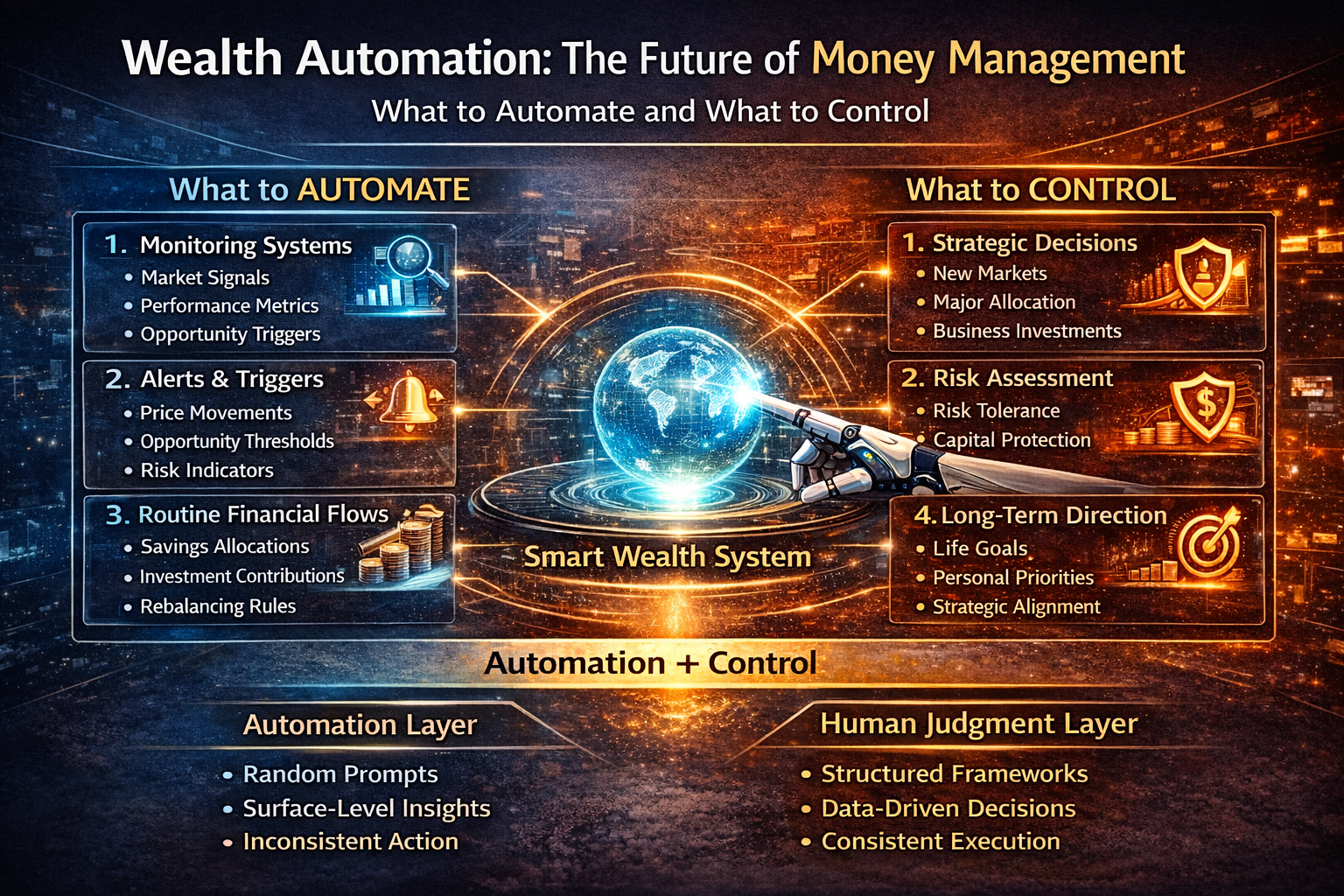
The Wealth Automation Framework
To use automation effectively, you must separate:
What to Automate
What to Control
What Should Be Automated
1. Monitoring Systems
Tracking:
- Market signals
- Performance metrics
- Opportunity triggers
Why Automate This
It is repetitive and data-heavy.
AI systems can monitor continuously without fatigue.
2. Alerts and Triggers
Automated notifications for:
- Price movements
- Opportunity thresholds
- Risk indicators
Outcome
You act faster and with better timing.
3. Routine Financial Flows
This includes:
- Savings allocations
- Investment contributions
- Rebalancing rules
Benefit
Consistency without relying on discipline alone.
4. Data Aggregation
Pulling data from:
- Accounts
- Investments
- Income sources
Result
A unified financial view without manual effort.
5. Performance Tracking
Automated analysis of:
- Returns
- Efficiency
- Growth trends
Advantage
Continuous feedback loop for improvement.
What Should NOT Be Fully Automated
This is where most people make mistakes.
1. Strategic Decisions
Decisions like:
- Entering new markets
- Major capital allocation
- Business investments
Why
These require context, judgment, and long-term thinking.
2. Risk Assessment
AI can assist, but:
Final risk tolerance must be human-defined.
3. Long-Term Direction
Wealth is not just numbers.
It involves:
- Life goals
- Personal priorities
- Strategic direction
4. High-Impact Moves
Large financial decisions should always involve:
- Validation
- Scenario review
- Human oversight
The Hybrid Automation Model
The most effective approach is:
Automation + Control
Automation Handles:
- Repetition
- Monitoring
- Alerts
- Data processing
Humans Handle:
- Strategy
- Direction
- Judgment
- Final decisions
How Platforms Enable This
Modern platforms like Water of Wealth AI are designed to:
- Automate low-value tasks
- Support high-value decisions
- Maintain user control
The Risk of Over-Automation
Some users try to automate everything.
This creates problems:
- Loss of awareness
- Blind execution
- Increased risk exposure
The Risk of Under-Automation
Others avoid automation entirely.
This leads to:
- Slow decision-making
- Missed opportunities
- Inconsistent execution
The Balanced Approach
The goal is not full automation.
It is:
Strategic automation
What Smart Users Are Doing
They are building systems where:
- Automation handles the workload
- AI provides intelligence
- Humans maintain control
The Compounding Effect
Automation creates consistency.
Consistency creates compounding.
Compounding creates wealth.
From Effort to Systems
Traditional thinking:
- Work harder
- Track more
- Analyze manually
Modern thinking:
- Build systems
- Automate processes
- Optimize continuously
The Future of Wealth Management
We are moving toward:
- Fully integrated systems
- Intelligent automation layers
- Continuous optimization environments
Final Insight
Automation is not optional anymore.
It is a core component of modern wealth systems.
But the advantage lies in:
What you automate — and what you choose to control
What Comes Next
Next:
From Income to Wealth: AI Systems That Scale Money
We will cover:
- How to move beyond earning
- How to structure scalable wealth systems
- How AI supports long-term financial growth
Activate the Water of Wealth AI™ Intelligence System
Identify early signals, evaluate real opportunities, structure capital decisions, and position before the market becomes crowded.
Leave a Reply