
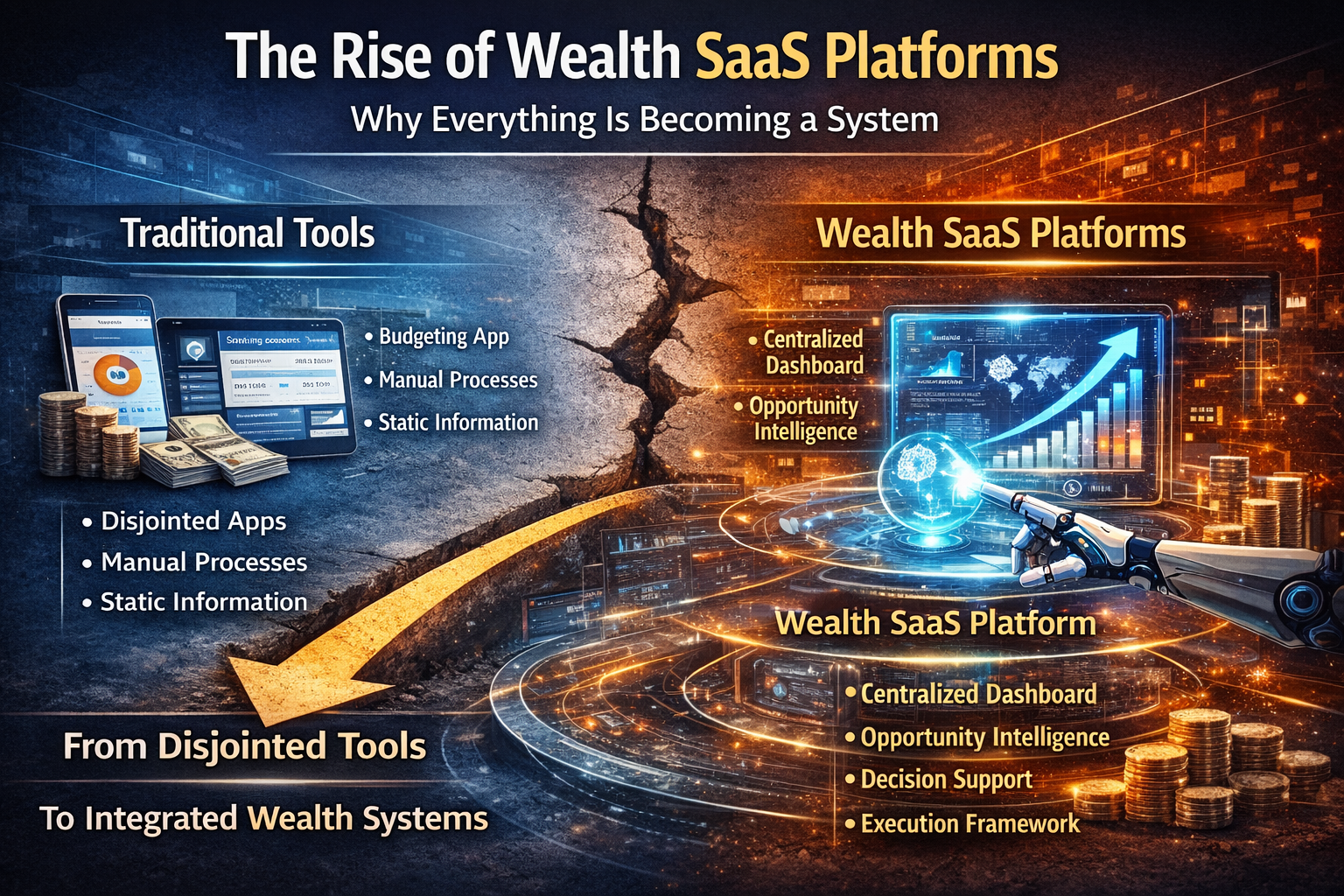
The way people build wealth is undergoing a structural shift.
What used to be:
- Advice-driven
- Manual
- Fragmented
Is rapidly becoming:
- System-driven
- Automated
- Integrated
At the center of this transformation is a new category:
Wealth SaaS platforms
What Is a Wealth SaaS Platform?
A Wealth SaaS (Software-as-a-Service) platform is a subscription-based system designed to help users:
- Build wealth
- Manage financial decisions
- Identify opportunities
- Execute strategies
- Optimize performance over time
Unlike traditional financial tools, these platforms are not isolated utilities.
They are continuous operating systems for wealth creation.
The Evolution: From Tools to Systems
To understand this shift, consider the progression:
Phase 1: Financial Tools
- Budget apps
- Expense trackers
- Investment dashboards
These focused on visibility.
Phase 2: Integrated Platforms
- Multi-account aggregation
- Portfolio management systems
These improved organization.
Phase 3: Wealth SaaS Systems (Current Phase)
- AI-powered decision engines
- Opportunity intelligence
- Scenario modeling
- Execution frameworks
These focus on outcomes.
Why Wealth Is Becoming SaaS
This shift is not random.
It is driven by structural changes in how money, data, and decisions interact.
1. Continuous Decision Environments
Wealth is no longer built through occasional decisions.
It requires:
- Constant monitoring
- Continuous evaluation
- Ongoing adjustment
SaaS platforms are designed for this.
2. Increasing Complexity
Modern wealth involves:
- Multiple income streams
- Diverse asset classes
- Digital and global opportunities
Managing this manually is inefficient.
3. Data-Driven Advantage
The volume of financial data has increased significantly.
SaaS systems can:
- Process
- Analyze
- Interpret
At a scale individuals cannot match.
4. Subscription-Based Intelligence
Instead of paying for one-time advice, users now access:
- Ongoing intelligence
- Continuous updates
- Evolving systems
This aligns with how wealth is actually built.
Key Features of Wealth SaaS Platforms
A true wealth SaaS platform includes:
1. Centralized Wealth Dashboard
A unified view of financial activity and structure.
2. Opportunity Intelligence Engine
Identification of emerging opportunities across markets and assets.
3. Decision Support System
Data-backed insights to guide financial choices.
4. Execution Framework
Structured pathways to act on opportunities.
5. Optimization Layer
Continuous tracking and refinement of performance.
How This Differs From Traditional Wealth Apps
Traditional apps:
- Show information
- Require manual interpretation
- Do not guide outcomes
Wealth SaaS platforms:
- Interpret information
- Provide direction
- Support execution
The Role of AI in Wealth SaaS
AI is the core engine behind modern wealth platforms.
It enables:
- Pattern recognition
- Predictive insights
- Scenario modeling
- Personalized recommendations
Platforms like Water of Wealth AI are built around this model.
Why This Model Is Scalable
Wealth SaaS platforms scale effectively because they:
- Operate continuously
- Improve with data
- Adapt to users
- Reduce reliance on manual processes
The Business Model Shift
The financial industry is also evolving.
Old Model:
- One-time consultations
- High advisory fees
- Limited access
New Model:
- Subscription access
- Continuous intelligence
- Scalable pricing
What This Means for Users
Users gain:
- Access to advanced financial systems
- Continuous strategic support
- Better decision-making tools
- Greater control over wealth outcomes
The Competitive Advantage
Users of wealth SaaS platforms operate differently.
They:
- Make faster decisions
- Identify opportunities earlier
- Structure wealth more effectively
- Adapt to changing environments
From Fragmentation to Integration
Previously, users relied on multiple disconnected tools:
- Banking apps
- Investment platforms
- Budget trackers
Now, everything is moving toward:
Integrated systems
The Strategic Implication
Wealth is no longer about:
- Isolated actions
It is about:
System design and execution
Early vs Late Adoption
As with most technology shifts:
Early adopters gain the advantage.
They:
- Learn faster
- Build systems earlier
- Compound results over time
Late adopters:
- React
- Follow trends
- Miss early opportunities
The Future Direction
Wealth SaaS platforms will continue evolving toward:
- Fully automated systems
- AI-driven execution layers
- Integrated financial ecosystems
Final Insight
The shift is clear:
Wealth is no longer managed manually.
It is operated through systems.
And those systems are increasingly:
- Intelligent
- Continuous
- Scalable
What Comes Next
Next:
How Smart Investors Use AI for Wealth Decisions
We will break down:
- Real decision frameworks
- How high-level users apply AI
- Practical examples of AI-driven strategy
Activate the Water of Wealth AI™ Intelligence System
Identify early signals, evaluate real opportunities, structure capital decisions, and position before the market becomes crowded.
Leave a Reply