
The term “wealth builder app” is being used everywhere.
But very few platforms actually qualify.
Most tools on the market are:
- Tracking apps
- Budgeting tools
- Basic investment dashboards
They are useful — but they are not designed to build wealth.
So the question becomes:
What actually makes a powerful wealth builder app?
The Core Principle
A true wealth builder app must do more than show information.
It must:
Drive better financial outcomes
The Shift in Expectations
Users are no longer looking for:
- Static dashboards
- Manual tools
- Generic insights
They are looking for:
- Intelligent systems
- Structured decision support
- Scalable wealth frameworks
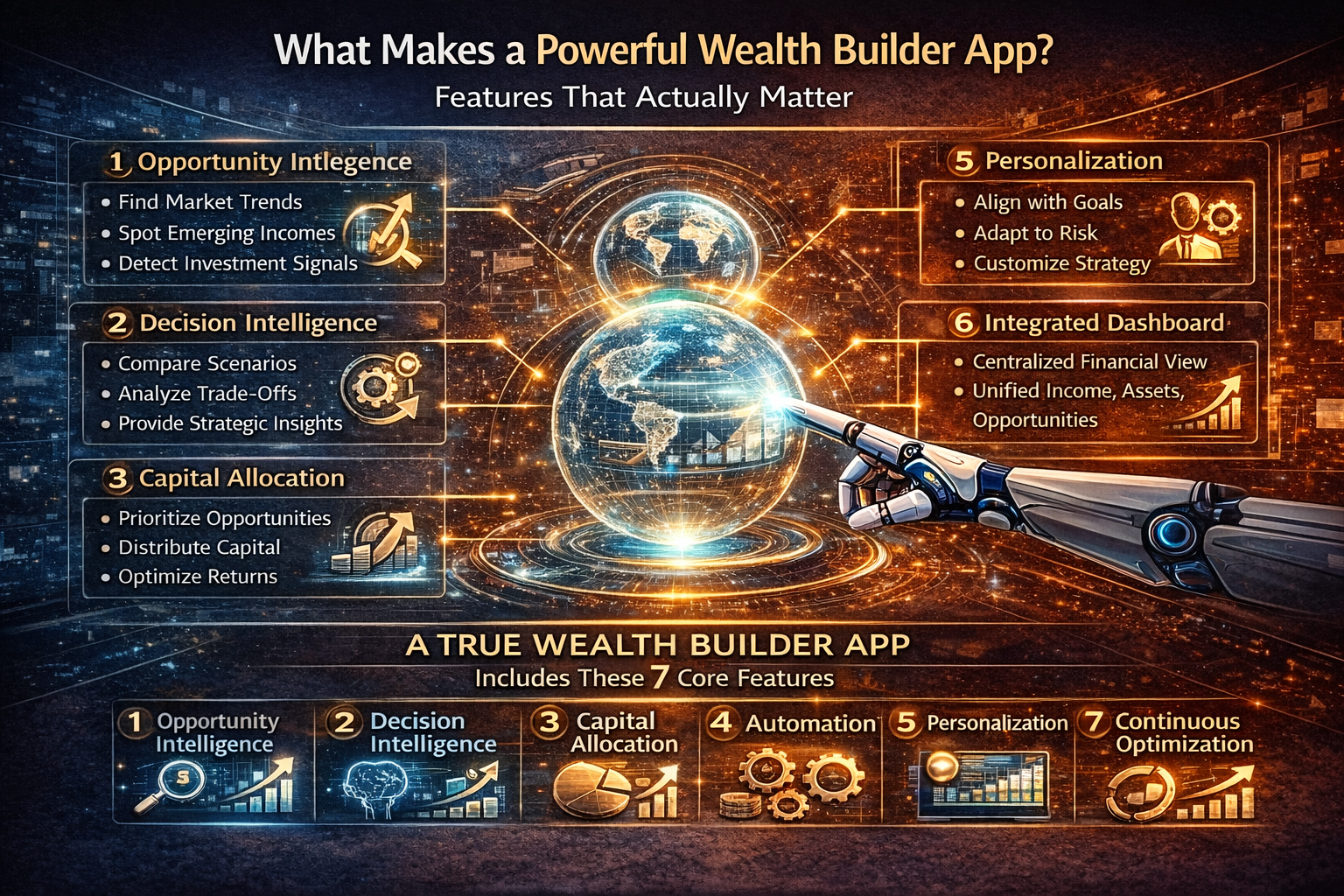
The 7 Core Features of a Real Wealth Builder App
To qualify as a true wealth-building system, a platform must include the following:
1. Opportunity Intelligence Engine
A powerful app must help users find opportunities, not just manage money.
This includes:
- Market trend detection
- Emerging income streams
- Investment signals
- Business opportunities
Why It Matters
Without opportunity discovery, users are forced to guess.
2. Decision Intelligence System
This is the most critical feature.
The platform should:
- Compare scenarios
- Analyze trade-offs
- Provide strategic insights
The Outcome
Users move from:
- Guesswork
To:
- Structured decision-making
3. Capital Allocation Guidance
Knowing where to allocate money is fundamental.
The app should help users:
- Prioritize opportunities
- Distribute capital effectively
- Optimize returns
4. Automation Layer
A powerful system reduces manual workload.
It should automate:
- Monitoring
- Alerts
- Routine financial flows
- Performance tracking
5. Personalization Engine
Every user is different.
The app must adapt to:
- Goals
- Risk tolerance
- Income level
- Strategy preferences
6. Integrated Wealth Dashboard
Users need a unified view of:
- Income
- Assets
- Opportunities
- Performance
Key Requirement
Everything should exist in one system.
Not across multiple disconnected tools.
7. Continuous Optimization System
Wealth is dynamic.
The app should continuously:
- Analyze performance
- Identify inefficiencies
- Suggest improvements
What Most Apps Get Wrong
Many platforms claim to be “wealth builders” but lack:
- Real intelligence
- Strategic guidance
- Execution support
Common Limitations
- Static dashboards
- No opportunity discovery
- Limited personalization
- No structured decision-making
The Difference Between Features and Systems
Most apps focus on:
Features.
But wealth builders require:
Systems
Feature-Based Apps
- Isolated tools
- Limited impact
- User-driven
System-Based Apps
- Integrated environment
- Outcome-focused
- Intelligence-driven
The Role of AI
AI is what enables the transition from features to systems.
It powers:
- Data analysis
- Pattern recognition
- Predictive insights
- Personalization
Platforms like Water of Wealth AI are built around this model.
How to Evaluate a Wealth Builder App
When assessing any platform, ask:
- Does it help me find opportunities?
- Does it improve my decision-making?
- Does it guide capital allocation?
- Does it automate key processes?
- Does it adapt to my situation?
- Does it operate as a system?
If the Answer Is No
Then it is not a true wealth builder.
The Strategic Advantage
Using the right platform allows users to:
- Make better decisions
- Move faster
- Scale more effectively
- Build structured wealth systems
The Future Standard
In the coming years, the definition of a wealth app will change.
From:
- Tracking tools
To:
- Intelligent wealth systems
Final Insight
A powerful wealth builder app is not defined by:
- How much data it shows
But by:
How effectively it helps you build wealth
What Comes Next
Next:
The Future of Wealth Creation in the AI Era
We will explore:
- Where this is all heading
- What changes are coming
- How to position yourself ahead of the curve
Activate the Water of Wealth AI™ Intelligence System
Identify early signals, evaluate real opportunities, structure capital decisions, and position before the market becomes crowded.
Leave a Reply